
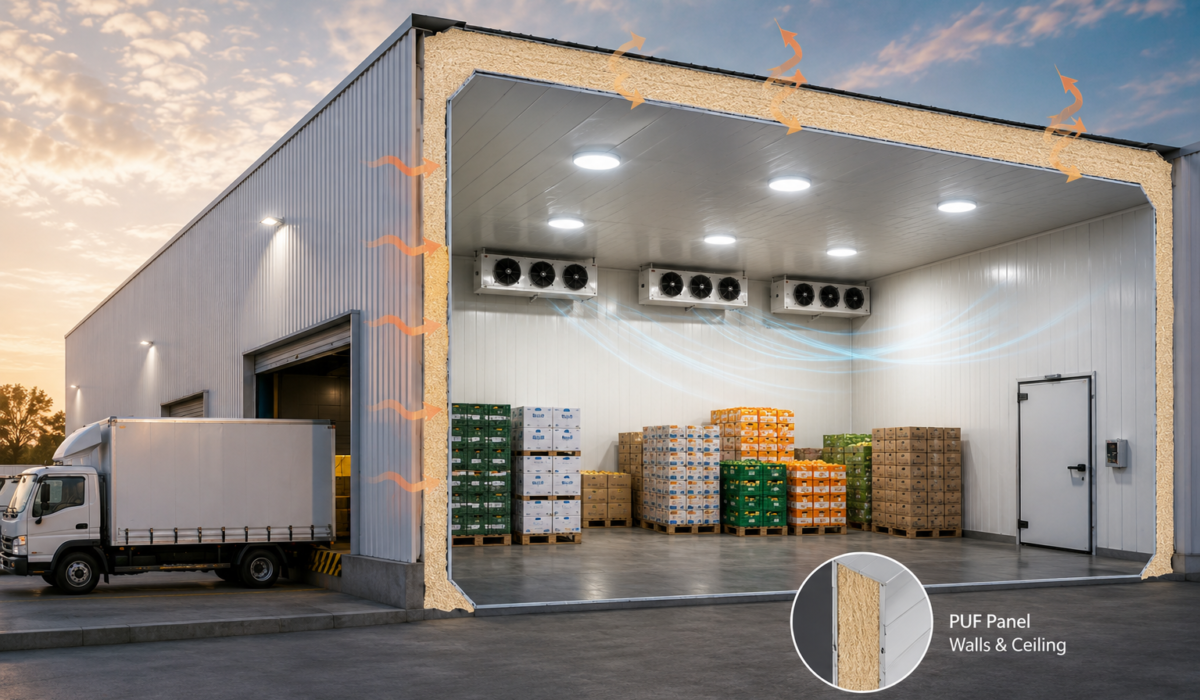
Maintaining a consistent temperature is one of the biggest operational challenges in any cold storage facility.
Whether you’re storing fruits and vegetables, dairy products, pharmaceuticals, frozen foods, or other temperature-sensitive materials, unwanted heat entering the cold room can make the refrigeration system work harder to maintain the required conditions.
This problem is often described as temperature leakage or heat gain.
The refrigeration system may be working correctly, yet the cold room still struggles to maintain its target temperature. In many cases, the problem isn’t the refrigeration equipment itself—it is the building envelope.
This is where properly designed PUF insulated panels can make a significant difference.
What Is Cold Storage Temperature Leakage?
Cold storage temperature leakage occurs when heat from the surrounding environment enters a refrigerated space.
A cold room may be maintained at a low temperature while the surrounding environment is considerably warmer. Heat naturally moves from the warmer environment toward the colder space.
If the walls, ceiling, doors, joints, or other parts of the enclosure have inadequate insulation or air leakage, additional heat enters the room.
That increases the refrigeration load.
ASHRAE guidance for refrigerated facilities specifically considers heat gain through walls and roofs and notes that thermal bridges can reduce the effective thermal resistance of an insulated assembly.
Why Traditional Roofing and Wall Systems Can Become a Problem
A conventional wall or roof assembly may not provide the continuous thermal barrier required for a cold storage environment.
Common problem areas include:
- Insufficient insulation thickness
- Gaps between insulation materials
- Poorly sealed panel joints
- Thermal bridges around structural components
- Damaged or deteriorated insulation
- Improperly fitted doors
- Frequent door opening and closing
Even when the insulation material itself performs well, poor detailing or installation can create weak points in the building envelope.
ASHRAE highlights the importance of accounting for thermal bridges because metal studs, ties and other components can create paths for additional heat transfer.
How PUF Panels Help Control Temperature Leakage
1. They Create a Continuous Insulated Barrier
PUF, or polyurethane foam, is widely used as insulation in refrigerated applications.
The Department of Energy notes that polyurethane foam is the most common insulation used in walk-in refrigeration applications in its evaluation of walk-in cooler and freezer technologies.
In a properly manufactured sandwich panel, the insulation core is positioned between protective metal facings.
This creates an integrated wall or ceiling element rather than relying on multiple separate layers assembled on site.
2. PUF Has Strong Thermal Insulation Properties
The effectiveness of insulation depends on factors such as material properties, thickness, construction quality, and operating conditions.
ASHRAE’s refrigerated-facility guidance lists polyurethane among the insulation materials used for cold storage and provides thermal conductivity data for polyurethane insulation.
The practical objective is simple: slow the movement of heat into the cold room.
Better insulation means the refrigeration system has less external heat gain to deal with, all else being equal.
3. Panel Joints Matter Just as Much as the Panel Core
Choosing a good insulation material is only part of the solution.
Cold storage panels must also be correctly joined and sealed.
Poorly fitted joints can create paths for air movement and moisture infiltration, potentially reducing the effectiveness of the overall enclosure.
This is why cold storage design should consider:
- Panel-to-panel joints
- Corner connections
- Ceiling-to-wall junctions
- Floor connections
- Door frames
- Service penetrations
- Refrigeration and electrical openings
The goal should be a properly sealed and continuous thermal envelope.
Don’t Ignore Cold Storage Doors
One of the most overlooked sources of temperature leakage isn’t the wall—it’s the door.
Every time a cold-room door is opened, warmer air can enter while conditioned air escapes.
ASHRAE identifies door selection and infiltration control as important considerations in refrigerated facilities. It recommends appropriate door designs and discusses solutions such as strip curtains, air curtains, and vestibules to reduce infiltration.
Therefore, installing high-quality PUF panels while ignoring poorly sealed or frequently open doors can undermine the overall system.
Insulation and access control need to work together.
What Happens When Cold Storage Insulation Is Inadequate?
Poor insulation can contribute to several operational problems:
Higher Refrigeration Load
More heat entering the cold room means the refrigeration system has more heat to remove.
Temperature Instability
The system may have greater difficulty maintaining the desired storage temperature, particularly during periods of high ambient temperature or heavy door traffic.
Condensation and Frost
Temperature differences and moisture infiltration can contribute to condensation or frost in poorly designed or poorly sealed areas.
Greater Equipment Stress
If refrigeration equipment operates under higher loads for longer periods, operating conditions can become more demanding.
Product Risk
Temperature-sensitive products require controlled storage conditions. Maintaining the specified temperature range is therefore an important part of cold-chain management.
How to Choose PUF Panels for a Cold Storage Facility
There isn’t one universal panel specification for every cold room.
The appropriate solution depends on factors such as:
- Required internal temperature
- External ambient conditions
- Room dimensions
- Panel thickness
- Insulation properties
- Joint design
- Door frequency
- Humidity conditions
- Floor construction
- Refrigeration system design
Instead of selecting panels purely on price or thickness, evaluate the complete cold-room envelope.
Indian Standards also recognize rigid polyurethane and polyisocyanurate foams for thermal insulation and specify requirements related to properties such as thickness, dimensional stability, thermal conductivity, and water-vapour transmission.
PUF Panels vs. Fixing Refrigeration Problems Alone
A common mistake is to immediately increase refrigeration capacity when a cold room struggles to maintain temperature.
That may address the symptom without addressing the cause.
Consider this sequence instead:
Identify heat gain → inspect the enclosure → check insulation → inspect joints and doors → assess refrigeration performance → select the appropriate corrective action.
If excessive heat gain is coming through the building envelope, improving insulation can be a more fundamental solution than simply adding refrigeration capacity.
The correct approach should be based on an assessment of the complete facility rather than assumptions.
Why PUF Panels Are a Practical Choice for Cold Storage
PUF insulated panels combine structural facing materials with a thermal insulation core, allowing them to function as an integrated building-envelope component.
Their applications include refrigerated rooms, cold rooms, freezers, and other temperature-controlled environments.
The U.S. Department of Energy’s research on walk-in coolers and freezers confirms that PUF is widely used in walk-in refrigeration panels.
For facility owners, the key benefit is not simply the material itself. The value comes from using an appropriately designed, properly installed insulated enclosure as part of the complete refrigeration system.
Why Choose SRR Modular Industries?
SRR Modular Industries provides insulated panel solutions designed for applications where thermal performance and controlled environments matter.
For cold storage projects, the right panel solution should be selected according to the required operating temperature, insulation requirements, room configuration, and installation conditions.
A properly designed panel system can help create a more consistent thermal envelope around the refrigerated space.
For businesses planning a new cold room or upgrading an existing facility, professional evaluation is important before finalizing panel specifications.
Conclusion
Cold storage temperature leakage is rarely caused by one factor.
Heat can enter through inadequately insulated walls and ceilings, thermal bridges, poorly sealed joints, doors, service openings, and other parts of the building envelope.
PUF insulated panels help address one of the most important pieces of this puzzle by providing a high-performance thermal barrier around the refrigerated space.
But the panel alone isn’t the complete solution.
Correct thickness, joint detailing, installation quality, door design, floor insulation, and refrigeration capacity must all be considered together.
If your cold storage facility is struggling to maintain its required temperature, don’t automatically assume that the refrigeration system needs to be upgraded. Start by examining where heat is entering the space.
Looking for PUF panel solutions for a cold storage project? Contact SRR Modular Industries to discuss your insulation and modular panel requirements.
Frequently Asked Questions
What causes temperature leakage in cold storage?
Temperature leakage generally refers to unwanted heat entering the refrigerated space. It can occur through walls, ceilings, floors, doors, joints, thermal bridges, and air infiltration.
Are PUF panels suitable for cold storage?
PUF is widely used as insulation in refrigerated facilities. The appropriate panel specification depends on the required temperature, insulation thickness, construction, and operating conditions.
Does thicker PUF always mean better cold storage performance?
Not necessarily. Thickness is important, but overall performance also depends on insulation properties, joints, thermal bridges, installation quality, doors, and other components of the cold-room envelope.
Can PUF panels reduce refrigeration load?
Effective insulation reduces heat transfer through the building envelope. Therefore, where inadequate insulation is a significant source of heat gain, improving the envelope can reduce the heat load that refrigeration equipment needs to remove. The actual impact must be calculated for the specific facility.
Why are cold-room doors important?
Doors can introduce warm air into refrigerated spaces whenever they are opened. Proper door selection, sealing, and infiltration-control measures are therefore important components of cold-storage design.