
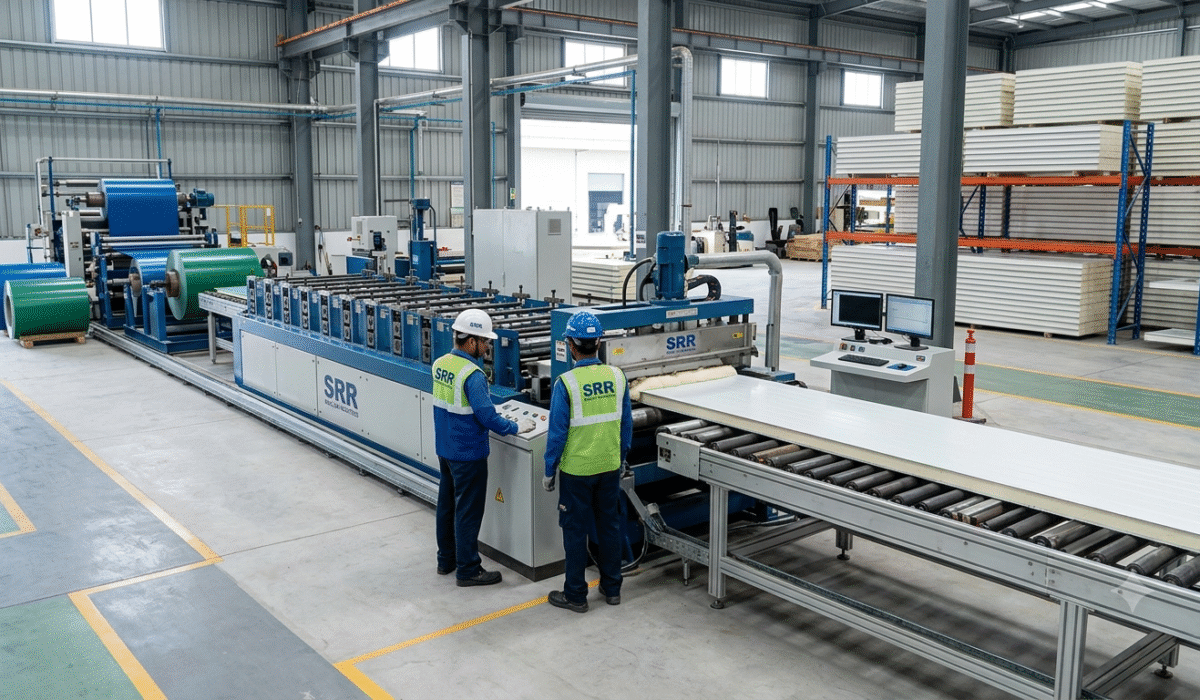
Modern industries demand building materials that are durable, energy-efficient, and quick to install. That’s why PUF (Polyurethane Foam) Panels have become the preferred choice for cleanrooms, cold storage facilities, warehouses, food processing plants, pharmaceutical units, and industrial buildings.
But have you ever wondered how PUF panels are actually manufactured?
At SRR Modular Industries, we believe informed customers make better decisions. In this guide, we’ll walk you through the complete PUF panel manufacturing process—from raw materials to quality inspection—so you understand what goes into producing a high-performance insulated panel.
What Is a PUF Panel?
A PUF Panel is a sandwich panel consisting of two metal sheets bonded to a rigid polyurethane foam (PUF) core. This combination provides excellent thermal insulation, structural strength, and long service life while keeping the panel lightweight.
The result is a construction material that’s ideal for temperature-controlled and hygienic environments.
Step 1: Selecting High-Quality Raw Materials
Every premium PUF panel begins with carefully selected raw materials.
At SRR Modular Industries, the manufacturing process starts with:
- Pre-painted Galvanized Iron (PPGI) sheets
- Galvalume sheets (optional)
- Polyurethane chemicals (Polyol & Isocyanate)
- Protective surface films
- Joint-locking accessories
The quality of these materials directly affects insulation performance, durability, and panel lifespan.
Step 2: Metal Sheet Preparation
Before insulation is added, the steel sheets undergo several preparation stages.
These include:
- Surface cleaning
- Thickness verification
- Width alignment
- Protective coating inspection
- Roll preparation
This ensures strong bonding between the metal skin and polyurethane foam.
Step 3: Roll Forming
The prepared metal sheets pass through precision roll-forming machines.
During this stage:
- The sheet profile is created.
- Locking edges are formed.
- Panel dimensions are standardized.
Accurate roll forming ensures faster installation and airtight joints during project execution.
Step 4: Polyurethane Foam Injection
This is the heart of the manufacturing process.
A precisely measured mixture of Polyol and Isocyanate is injected between the two steel sheets.
The chemical reaction causes the foam to expand rapidly, filling every part of the panel evenly.
This creates:
- High-density insulation
- Uniform foam structure
- Strong bonding with metal sheets
The foam core becomes the thermal barrier responsible for the panel’s insulation performance.
Step 5: Continuous Lamination
Once the foam expands, the panel moves through a continuous lamination system.
During this stage:
- Controlled pressure is applied.
- Foam density remains consistent.
- The panel thickness is maintained accurately.
- Adhesion between layers becomes permanent.
Continuous lamination improves structural integrity and dimensional stability.
Step 6: Cooling and Curing
After lamination, the panel is allowed to cool and cure.
Proper curing ensures:
- Maximum foam strength
- Stable dimensions
- Improved insulation efficiency
- Long-term durability
Skipping this stage or reducing curing time can affect panel quality.
Step 7: Precision Cutting
Once fully cured, panels are cut according to customer specifications.
Common thickness options include:
- 50 mm
- 75 mm
- 100 mm
- 120 mm
- 150 mm
Lengths are customized based on project requirements to reduce wastage during installation.
Step 8: Quality Inspection
Before dispatch, every panel undergoes quality checks.
Typical inspections include:
✔ Thickness measurement
✔ Width verification
✔ Surface finish inspection
✔ Joint alignment
✔ Foam consistency
✔ Visual damage inspection
Quality control ensures every panel meets project specifications before leaving the factory.
Step 9: Packing and Dispatch
Finished panels are:
- Covered with protective film
- Packed securely
- Loaded carefully
- Transported to customer sites
Proper packaging prevents scratches, dents, and moisture damage during transit.
Why Manufacturing Quality Matters
Not all PUF panels are manufactured to the same standards.
The manufacturing process directly influences:
- Thermal insulation performance
- Energy efficiency
- Structural strength
- Moisture resistance
- Installation speed
- Product lifespan
Poor manufacturing practices can lead to uneven foam density, weak bonding, and reduced insulation efficiency.
That’s why choosing an experienced manufacturer is just as important as choosing the right panel.
Applications of PUF Panels
PUF panels are widely used across industries, including:
- Pharmaceutical Cleanrooms
- Cold Storage Facilities
- Food Processing Plants
- Laboratories
- Industrial Warehouses
- Manufacturing Units
- Commercial Buildings
- Roofing & Wall Cladding
- Modular Offices
Their versatility makes them suitable for both new construction and renovation projects.
Why Choose SRR Modular Industries
At SRR Modular Industries, we manufacture high-quality PUF panels designed for modern industrial applications.
Our focus is on delivering products that combine:
- Reliable thermal insulation
- Consistent manufacturing quality
- Custom panel dimensions
- Durable construction
- Timely project support
Whether you’re building a cleanroom, cold storage facility, industrial warehouse, or modular workspace, our team works closely with you to provide solutions tailored to your project requirements.
Frequently Asked Questions
1.What is inside a PUF panel?
A rigid polyurethane foam core is sandwiched between two metal sheets, providing insulation and structural strength.
2.Are PUF panels waterproof?
PUF panels are moisture-resistant, and when installed with proper sealing and joint systems, they help protect structures from water ingress.
3.What thickness of PUF panel should I choose?
The appropriate thickness depends on your application. Cleanrooms, cold storage facilities, and industrial buildings may require different specifications based on insulation needs.
4.How long do PUF panels last?
High-quality PUF panels manufactured using proper processes and installed correctly can provide reliable performance for many years with minimal maintenance.
Conclusion
The performance of a PUF panel starts long before it reaches your project site. Every stage—from raw material selection and foam injection to lamination, curing, and quality inspection—plays a critical role in ensuring durability, insulation, and long-term efficiency.
At SRR Modular Industries, we combine quality manufacturing practices with industry expertise to deliver insulated panel solutions for cleanrooms, cold storage facilities, pharmaceutical units, food processing plants, and industrial infrastructure.
If you’re planning your next project, choosing a trusted manufacturer ensures you get panels that perform reliably for years to come.