

In modern construction, choosing the right building material can directly impact energy efficiency, durability, and long-term costs. Two popular options widely used in industrial sheds, cold storages, warehouses, commercial buildings, and prefab structures are PUF panels and sandwich panels.
Many buyers often assume these two terms mean the same thing. However, there are important differences between them that affect performance, insulation, fire resistance, and applications. Understanding the difference between PUF panels and sandwich panels helps builders, architects, and business owners make smarter decisions.
At Sri Raja Rajeswari Industries, we provide high-quality insulation and roofing solutions designed for industrial and commercial requirements. In this guide, we will compare PUF panels vs sandwich panels in detail, helping you select the right solution for your project.
What is a PUF Panel?
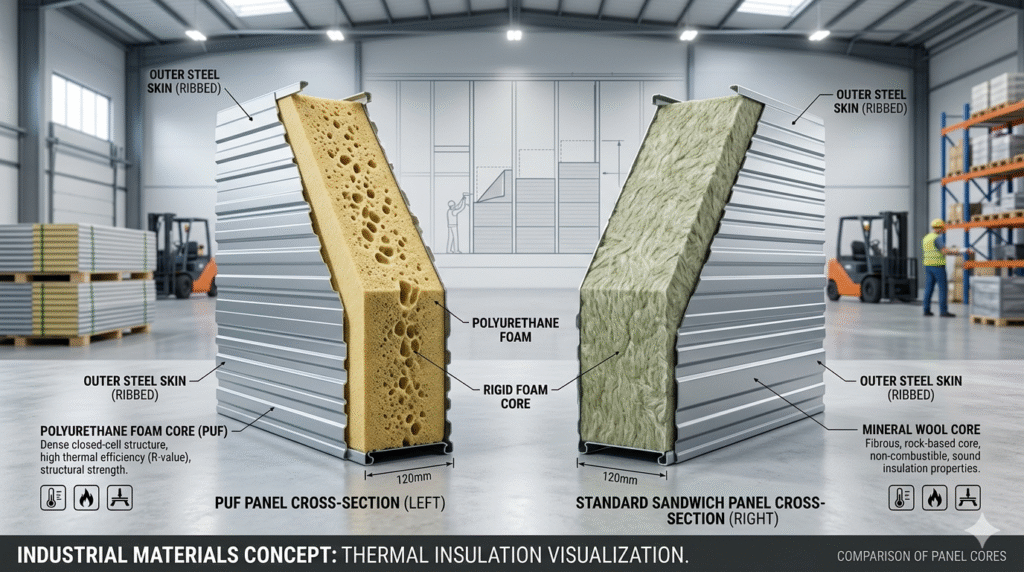
PUF panel stands for Polyurethane Foam panel. It is a type of insulated panel made with a rigid polyurethane foam core placed between two metal sheets, usually PPGI or galvanized steel.
PUF panels are mainly known for:
- Excellent thermal insulation
- Lightweight structure
- Energy efficiency
- Fast installation
- Moisture resistance
These panels are widely used in:
- Cold storage units
- Food processing plants
- Pharmaceutical facilities
- Industrial warehouses
- Prefabricated buildings
- Clean rooms
PUF panels are considered one of the most efficient insulation materials due to their low thermal conductivity
What is a Sandwich Panel?
A sandwich panel is a broader category of construction panel that consists of three layers:
- Outer metal sheet
- Insulation core material
- Inner metal sheet
The core material can vary depending on the requirement. Common types include:
- PUF (Polyurethane Foam)
- EPS (Expanded Polystyrene)
- Rockwool
- PIR (Polyisocyanurate)
This means every PUF panel is technically a sandwich panel, but not every sandwich panel is a PUF panel.
Sandwich panels are commonly used in:
- Industrial buildings
- Roofing systems
- Wall cladding
- Commercial structures
- Temporary site offices
- Modular buildings
PUF Panel vs Sandwich Panel: Key Differences
1. Insulation Performance
PUF Panels
PUF panels provide superior thermal insulation because polyurethane foam has very low thermal conductivity. This helps maintain stable indoor temperatures and reduces energy consumption.
Sandwich Panels
Insulation performance depends on the core material used. EPS sandwich panels offer moderate insulation, while Rockwool panels focus more on fire resistance and soundproofing.
Winner:
PUF panels are better for projects requiring high thermal efficiency.
2. Energy Efficiency
PUF Panels
PUF insulated panels can significantly reduce cooling and heating costs. They are highly preferred in cold storage and temperature-controlled environments.
Sandwich Panels
Standard sandwich panels with EPS cores provide decent insulation but are generally less energy efficient compared to PUF panels.
Winner:
PUF panels deliver better long-term energy savings
3. Fire Resistance
PUF Panels
Standard PUF panels provide moderate fire resistance. However, fire-retardant PIR variants are available for enhanced safety.
Sandwich Panels
Rockwool sandwich panels are known for superior fire resistance and are often chosen for industries with strict fire safety requirements.
Winner:
Rockwool sandwich panels perform better in fire-sensitive applications.
4. Structural Strength
PUF Panels
PUF panels are lightweight yet structurally strong. Their rigid foam core enhances durability while reducing overall building load.
Sandwich Panels
Strength varies depending on the panel type and core material. Some sandwich panels may require additional support structures.
Winner:
PUF panels offer a strong balance of strength and lightweight performance
5. Installation Speed
PUF Panels
PUF panels are prefabricated and easy to install, reducing labor costs and project timelines.
Sandwich Panels
Most sandwich panels also support quick installation, though heavier materials like Rockwool may require more handling effort.
Winner:
PUF panels are generally easier and faster to install.
6. Cost Comparison
PUF Panels
The initial cost of PUF panels may be slightly higher, but the long-term savings in energy and maintenance make them cost-effective.
Sandwich Panels
EPS sandwich panels are usually more affordable upfront and suitable for budget-conscious projects.
Winner:
- Short-term budget: Sandwich panels
- Long-term value: PUF panels
Comparison Table: PUF Panel vs Sandwich Panel
| Feature | PUF Panels | Sandwich Panels |
|---|---|---|
| Thermal Insulation | Excellent | Moderate to High |
| Energy Efficiency | Very High | Depends on core |
| Fire Resistance | Moderate to High | Varies by material |
| Weight | Lightweight | Moderate |
| Installation | Fast & Easy | Easy |
| Cost | Higher initial investment | Budget-friendly options available |
| Durability | High | Depends on panel type |
| Best Applications | Cold storage, pharma, clean rooms | Warehouses, offices, roofing |
Applications of PUF Panels
PUF panels are ideal for industries that require temperature control and insulation.
Common applications include:
- Cold storage facilities
- Food processing industries
- Pharmaceutical manufacturing
- Clean rooms
- Prefabricated structures
- Industrial sheds
- Refrigerated transport units
Their superior insulation performance makes them a preferred solution for energy-efficient construction
Applications of Sandwich Panels
Sandwich panels are versatile and suitable for a wide range of construction projects.
They are commonly used in:
- Warehouse roofing
- Commercial buildings
- Site offices
- Portable cabins
- Industrial wall cladding
- Factory partitions
- Acoustic enclosures
Different core materials can be selected based on project requirements such as insulation, fire safety, or soundproofing.
Why Choose Sri Raja Rajeswari Industries?
At Sri Raja Rajeswari Industries, we understand that every project has unique requirements. Our team helps customers choose the right insulation and panel solution based on performance, durability, and budget.
We focus on:
- High-quality manufacturing
- Durable and reliable materials
- Custom panel solutions
- Timely delivery
- Cost-effective pricing
- Expert technical support
Whether you need PUF insulated panels for cold storage or sandwich panels for industrial roofing, we provide solutions built for long-term performance.
Conclusion
When comparing PUF panel vs sandwich panel, the right choice depends on your project goals.
If your priority is superior insulation, energy efficiency, and long-term savings, PUF panels are the better option. They are ideal for cold storage, pharmaceuticals, food processing, and temperature-sensitive environments.
On the other hand, sandwich panels offer flexibility and affordability, especially when different core materials are used for specific requirements like fire resistance or acoustic insulation.
At Sri Raja Rajeswari Industries, we help businesses select the right panel systems for durable, efficient, and cost-effective construction.
FAQs
Are PUF panels and sandwich panels the same?
No. A sandwich panel is a general category of insulated panel, while a PUF panel is a type of sandwich panel that uses polyurethane foam as the core material.
Which panel offers better insulation?
PUF panels provide better thermal insulation due to their low thermal conductivity.
Are PUF panels suitable for cold storage?
Yes. PUF panels are widely used in cold storage facilities because they help maintain stable temperatures efficiently.
Which sandwich panel is best for fire resistance?
Rockwool sandwich panels are considered better for high fire resistance applications.
Are sandwich panels cost-effective?
Yes. Sandwich panels are generally affordable and reduce construction time, making them cost-effective for many industrial and commercial projects.
How long do PUF panels last?
High-quality PUF panels can last 25–30 years with proper installation and maintenance.