

You’ve probably heard builders mention PUF panels when discussing modern construction or cold storage solutions. But most people don’t fully understand what they are or why they’re rapidly replacing brick and concrete. In this guide, you’ll learn exactly what a PUF panel is, how it works, where it’s used, and how to choose the right one.
Key Takeaways
- PUF panels are insulated sandwich panels made of polyurethane foam between metal sheets.
- Polyurethane foam provides high thermal insulation due to its closed-cell structure.
- PUF panels are widely used in cold storage, prefab buildings, and industrial construction.
- Lightweight construction and quick installation reduce labor and project time.
- Energy efficiency from PUF panels lowers long-term operational costs.
- Choosing the right panel depends on thickness, application, and environmental conditions.
What Is a PUF Panel and How Does It Work?
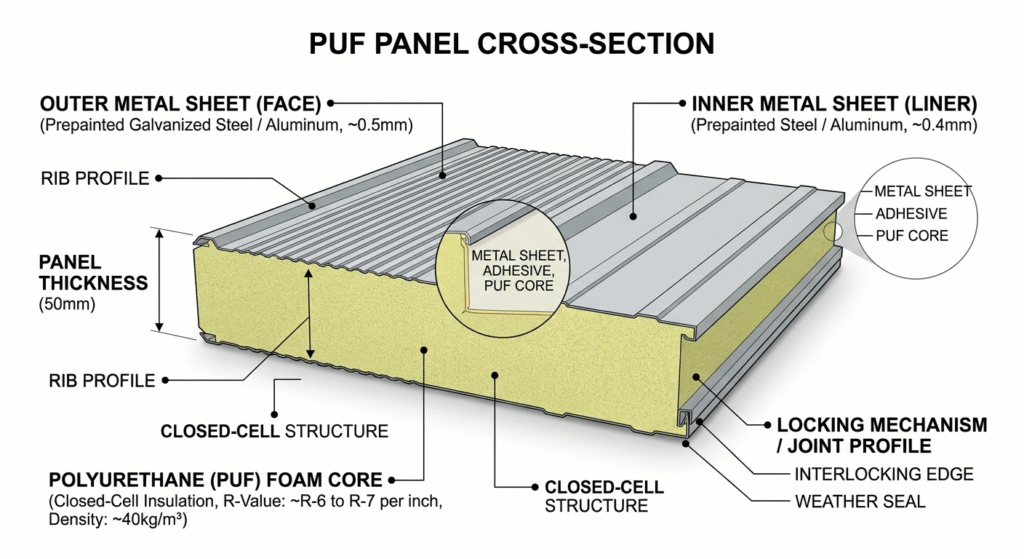
PUF panels are insulated sandwich panels made of a polyurethane foam core bonded between two metal sheets.
First, a PUF (Polyurethane Foam) panel consists of three layers: an inner insulating core and two outer protective sheets, typically made of galvanized iron (GI) or aluminum. This structure creates a rigid yet lightweight building material.
Second, polyurethane foam insulation works by trapping air in a closed-cell structure, reducing heat transfer. For example, in a cold storage unit, this structure prevents outside heat from entering, keeping the internal temperature stable.
Third, PUF panels function as both structural and insulating materials, which means you don’t need separate insulation layers. This reduces construction complexity and cost.
Why Are PUF Panels Important in Modern Construction?
PUF panels are important because they provide superior insulation, faster construction, and long-term energy savings.
First, thermal insulation efficiency is the biggest advantage. Buildings lose up to 30% of energy through poor insulation — Source: International Energy Agency, 2023. PUF panels minimize this loss significantly.
Second, energy savings make them cost-effective. For example, cold storage facilities using PUF panels can reduce electricity consumption by 25–35% — Source: ASHRAE, 2022.
Third, lightweight construction reduces structural load. This allows faster building and lower foundation costs compared to brick walls.
Fourth, quick installation speeds up projects. A warehouse built with PUF panels can be completed up to 50% faster — Source: McKinsey Construction Report, 2021.
What Are the Different Types of PUF Panels?
PUF panels come in multiple types based on their application, including wall panels, roof panels, and cold storage panels.
Wall PUF Panels
First, wall panels are designed for vertical applications like partitions and building walls. These panels provide structural strength along with insulation.
For example, prefabricated offices often use wall panels to create insulated interiors quickly.
Roof PUF Panels
Second, roof panels are engineered to withstand weather conditions such as rain, heat, and wind loads. They often include corrugated or trapezoidal profiles.
For example, industrial sheds commonly use PUF roofing panels for durability and insulation.
Cold Storage Panels
Third, cold storage panels are specialized for temperature-controlled environments. These panels are thicker and offer higher insulation performance.
For example, food storage units rely on these panels to maintain temperatures as low as -40°C.
Sandwich Panels
Finally, PUF sandwich panels refer to the layered structure combining insulation and metal sheets. This is the most common format used across industries.
How Do PUF Panels Work for Insulation?
PUF panels work by using closed-cell foam that resists heat transfer and prevents air leakage.
First, the closed-cell structure traps gas within tiny cells, creating a barrier against heat flow. This is why polyurethane has one of the lowest thermal conductivity values among insulation materials.
Second, air sealing prevents energy loss. For example, in warehouses, PUF panels eliminate gaps where heat or cold air could escape.
Third, moisture resistance enhances performance. Unlike traditional materials, PUF panels do not absorb water easily, maintaining insulation efficiency.
What Are the Key Advantages of PUF Panels?
PUF panels offer advantages such as high insulation, durability, lightweight construction, and cost efficiency.
First, excellent thermal insulation reduces energy costs. For example, HVAC systems work less when buildings retain temperature efficiently.
Second, durability ensures long lifespan. PUF panels can last 25–40 years with minimal maintenance — Source: Building Materials Journal, 2022.
Third, lightweight panels simplify transport and installation. This reduces labor requirements significantly.
Fourth, fire-resistant variants improve safety. Many panels are treated to meet fire safety standards.
Fifth, eco-friendly construction reduces carbon footprint. Energy-efficient buildings contribute to sustainability goals.
Where Are PUF Panels Commonly Used?
PUF panels are widely used in cold storage, prefab buildings, industrial sheds, and clean rooms.
First, cold storage facilities rely on PUF panels for temperature control. For example, pharmaceutical storage units use them to maintain strict temperature ranges.
Second, prefabricated buildings use PUF panels for fast construction. These include site offices, portable cabins, and modular homes.
Explore more in [Internal link: “prefabricated building advantages” → suggested target page/topic].
Third, industrial sheds benefit from PUF roofing and wall panels. These structures require durability and insulation.
Fourth, clean rooms depend on airtight insulation. For example, hospitals and labs use PUF panels to maintain sterile environments.
How Do PUF Panels Compare to Brick and Concrete Walls?
PUF panels outperform traditional materials like brick and concrete in insulation, speed, and efficiency.
| Feature | PUF Panels | Brick Walls | Concrete Walls |
|---|---|---|---|
| Insulation | Excellent | Moderate | Low |
| Construction Time | Fast | Slow | Slow |
| Weight | Lightweight | Heavy | Very Heavy |
| Cost Efficiency | High (long-term) | Medium | Medium |
| Energy Savings | High | Low | Low |
First, PUF panels provide better insulation than bricks. For example, brick walls often require additional insulation layers.
Second, construction speed is significantly faster. A prefab structure can be completed in weeks instead of months.
Third, PUF panels reduce operational costs. This makes them ideal for energy-intensive industries.
What Is the Cost of PUF Panels per Square Foot?
PUF panel cost in India typically ranges between ₹1,000 to ₹2,500 per square meter depending on specifications.
First, thickness affects pricing. Thicker panels (60mm–150mm) cost more due to better insulation.
Second, material quality impacts cost. For example, aluminum-coated panels are more expensive than GI sheets.
Third, project size influences pricing. Bulk orders often reduce per-unit cost.
Fourth, installation and transport add to total cost. These factors vary by location and project complexity.
For detailed planning, see construction cost estimation guide
Are PUF Panels Durable and Weather-Resistant?
PUF panels are highly durable and resistant to weather conditions such as heat, rain, and corrosion.
First, metal coatings protect against rust and corrosion. For example, pre-coated GI sheets extend panel lifespan.
Second, foam core maintains structural integrity even under temperature fluctuations.
Third, panels resist moisture and fungal growth, making them suitable for humid environments.
What Is the Lifespan of a PUF Panel Structure?
PUF panel structures typically last between 25 to 40 years with proper maintenance.
First, quality materials extend lifespan. High-density foam and coated metals improve durability.
Second, maintenance practices matter. For example, periodic inspection prevents damage from external factors.
Third, environmental conditions influence longevity. Coastal areas may require additional protection.
Tools, Brands, or Practical Examples of PUF Panels
PUF panels are manufactured by specialized companies and used in real-world construction projects across industries.
First, companies like Sri Raja Rajeswari Industries produce high-quality panels for industrial and commercial use.
Second, real-world use cases include warehouses, cold chains, and modular offices. For example, logistics companies use PUF panels to maintain temperature-sensitive goods.
Third, installation involves interlocking prefabricated panels. This creates airtight and thermally efficient structures.
What Factors Should You Consider Before Buying PUF Panels?
Choosing the right PUF panel depends on application, thickness, material quality, and environmental conditions.
First, identify your application. For example, cold storage requires thicker panels than office partitions.
Second, check insulation requirements. Higher R-value panels provide better thermal resistance.
Third, evaluate material quality. Look for corrosion-resistant coatings and certified foam density.
Fourth, consider budget and long-term savings. Cheaper panels may cost more in energy bills.
What’s Next: How to Choose the Right PUF Panel for Your Project?
Selecting the right PUF panel involves balancing performance, cost, and application-specific requirements.
Follow this checklist:
- Define project type (warehouse, cold storage, office)
- Choose appropriate thickness (30mm–150mm)
- Verify manufacturer certifications
- Compare pricing and warranties
- Assess installation support
By following these steps, you can ensure optimal performance and cost efficiency.
Conclusion
PUF panels are a modern construction solution that combines insulation, durability, and efficiency in one material.
They reduce energy consumption, speed up construction, and offer long-term cost savings. Whether you’re building a warehouse, cold storage unit, or prefab structure, PUF panels provide a reliable and scalable solution.
If you’re planning your next project, now is the time to consider switching to energy-efficient insulated panels.
Written by Construction Materials Expert Team (10+ years in industrial building solutions)
Reviewed by Senior Structural Engineer (Specialist in prefab and insulation systems)